Welcome to Hengtong Electric

Sales Hotline+86 183-6493-6808
Sales Hotline+86 183-6493-6808

 Binzhou Hengtong Electric Power Equipment Co., Ltd.
Phone: +86 183-6493-6808
Service: +86 183-6493-6808
Address: No. 112, Qianqiao Village, Haifeng Subdistrict, Wudi County, Binzhou, Shandong, China
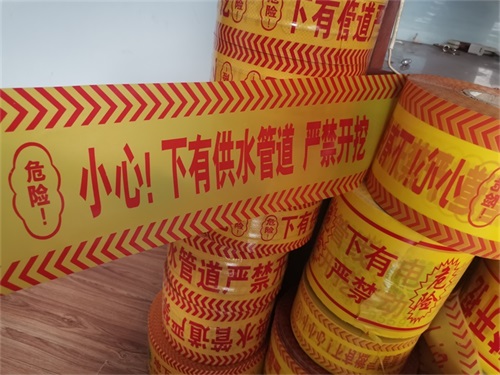
The laying of warning tape is convenient for construction, and construction and burial are carried out simultaneously. It is buried in the middle of the underground and pipeline, and laid 30-50 cm above the pipeline to serve as a warning sign, to prevent unnecessary damage to the pipeline during excavation and construction in the future, which may cause major accidents, and to avoid huge property and economic losses caused by accidental damage. It is an economically effective, simple and easy to implement tool for the safety protection of various directly buried pipelines and cables.
Laying of cable warning tape below
(1) The warning tape for the trace cable should be laid 300-500 mm above the top of the pipe (to ensure that the trace tape does not harm the pipeline during construction), but it should not be laid in the roadbed or road surface.
(2) For pipes with a diameter not exceeding 400 mm, a cable warning tape can be laid above; For pipelines larger than 400 mm, two horizontal cable warning tapes with a clear distance of 100-200 mm should be laid parallel above the pipeline.
(3) During the laying process, the connection between the two trace cable warning tapes should be overlapped by about 1 meter. At the overlap, the PE film on one side of the aluminum foil should be peeled off to expose the aluminum foil, allowing the aluminum foils of the two trace tapes to fully contact each other. The overlapping part should be tightly wrapped with plastic tape to ensure firm adhesion and conductivity after power on
(4) At the end of the PE pipe, if the trace tape does not lead out of the ground, it should be peeled off 50 centimeters long to allow the aluminum foil to fully contact the ground. The aluminum foil forms a circuit with the ground, reducing contact resistance and improving detection quality.
(5) During the laying process, a signal source well can be set up to lead out the trace strip and leave it 1 meter inside the well for easy detection.
(6) The overall embossing of the tracking tape is formed and placed in rolls for transportation. The tracking tape will not stretch out after being uncoiled. During construction, open the tracking tape 4-5 meters, and two people use their hands to grab both ends and pull them flat with force. After releasing their hands, the tracking tape will flatten. Then proceed with the laying.
(7) Partial over excavation should be backfilled and compacted. When there is no groundwater at the bottom of the ditch, if the over excavation is within 0.15m, the original soil can be used for backfilling; If the over excavation is above 0.15, lime soil treatment can be used. When there is groundwater or a large amount of water at the bottom of the ditch, graded sand or natural sand should be used to backfill to the elevation. After backfilling the over excavated part, the compactness should be close to the compactness of the natural soil in the original foundation.
(8) In areas with collapsible loess, it is not advisable to carry out construction during rainy periods or to effectively drain the accumulated water in the ditch. During excavation, a soil layer with a thickness of 0.03-0.06m should be reserved at the bottom of the ditch for compaction treatment.
(9) When encountering abandoned structures, hard stones, wood, garbage and other debris at the bottom of the ditch, they must be removed, and a layer of sand or plain soil with a thickness of no less than 0.15m should be laid, leveled and compacted to the design elevation.
(10) Frozen soil, garbage, wood, and soft materials shall not be used for backfilling. The backfill soil on both sides of the pipeline and within 0.5m above the top of the pipeline shall not contain debris such as crushed stones and bricks, and shall not be filled with gray soil. The number of stones in the backfill soil at a distance of more than 0.5m from the top of the pipe shall not exceed 10%, and the diameter shall not exceed 0.1m, and shall be evenly distributed.
(11) Backfill soil should be compacted in layers, with a virtual paving thickness of 0.2-0.3m for each layer. Backfill soil on both sides of the pipeline and within 0.5m above the pipe top must be manually compacted. Backfill soil above 0.5m above the pipe top can be compacted using small machinery, and the virtual paving thickness for each layer should be 0.25-0.4m.
(12) Warning tapes should be continuously laid along the buried gas pipelines. Before laying the warning tape, the surface should be compacted and laid flat above the pipeline. The distance from the pipeline should be 0.3-0.5 meters, but it should not be laid in the roadbed or road surface.
This article is supported by cable warning tapes. For more detailed and exciting content, please click on our website http://webtest2.daoshangbao.cn We will wholeheartedly provide you with satisfactory service.

 Phone: +86 183-6493-6808
 Address: No. 112, Qianqiao Village, Haifeng Subdistrict, Wudi County, Binzhou, Shandong, China
 Binzhou Hengtong Electric Power Equipment Co., Ltd.
 ICP record: Shandong ICP 2022018583-1
Shandong Public Security Record 37162302000525

Scan this code in WeChat