There are currently various types of tracer wire on the market, such as copper clad steel, copper core PVC insulated cables (hereinafter referred to as copper core wires), copper clad aluminum, and so on. Which tracer wire is better and more conducive to long-term tracing and positioning management of buried gas pipelines? It is necessary to test the performance of the tracer wire in order to choose a more suitable tracer wire. Therefore, we conducted tests on the commonly used tracer wire for the three types of PE gas pipelines mentioned above, providing reference for the selection of tracer wire for PE gas pipelines in terms of their conductivity, anti-corrosion treatment of tracer wire joints, and strength.
Testing principle of tracer wire
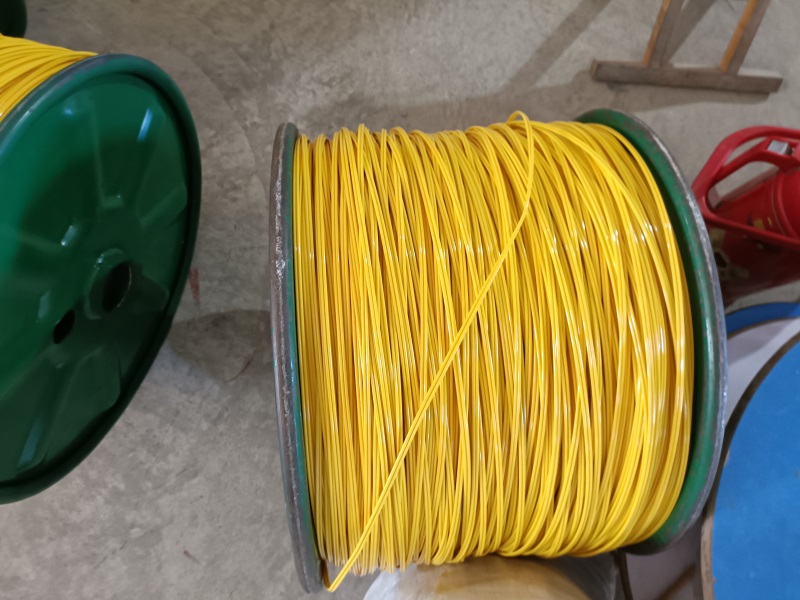
Copper clad steel is a metal core composed of steel core wires and a tightly wrapped copper layer, with a PE anti-corrosion layer on the outer side. Copper plays a role in conducting weak electrical signals, while steel wire plays a supporting role. Copper core wires are generally composed of an inner layer of copper core wire, an insulating sheath in the middle layer, and an outer protective sheath. Copper clad aluminum consists of an aluminum core wire and a copper layer tightly wrapped around it to form a metal core, with an outer layer of PE anti-corrosion coating.
Due to the fact that the anti-corrosion layer of the outer layer of steel gas pipelines is a plastic layer or coating with insulation and anti-corrosion properties, similar in structure to the outer layers of copper clad steel, copper core wires, copper clad aluminum, etc., which also have insulation and anti-corrosion properties. Therefore, we equate the two and use the PCM pipeline current decay rate method [1] to detect the average insulation quality of the trace line anti-corrosion layer. The detection principle is to apply a current signal of a certain frequency to the tracer wire, and the current will gradually decay when transmitted from the tracer wire to the distance. The magnitude of its attenuation is related to the insulation resistivity of the plastic layer of the tracer wire. The higher the average insulation resistivity of the plastic layer of the tracer wire, the slower the current attenuation, and vice versa, the faster the attenuation.
This article is dedicated to friendship with buried warnings. For more information, please click on: http://webtest2.daoshangbao.cn Sincere attitude. We will provide you with comprehensive services. We will gradually contribute more relevant knowledge to everyone. Stay tuned


 Binzhou Hengtong Electric Power Equipment Co., Ltd.

 Phone: +86 183-6493-6808
 Address: No. 112, Qianqiao Village, Haifeng Subdistrict, Wudi County, Binzhou, Shandong, China
 Binzhou Hengtong Electric Power Equipment Co., Ltd.
 ICP record: Shandong ICP 2022018583-1
Shandong Public Security Record 37162302000525