At present, there are many kinds of trace lines on the market. Which kind of tracer wire is better, which is more conducive to the long-term tracking and positioning management of buried natural gas pipelines. It is necessary to test the performance of the tracer wire to select a more suitable tracer. Wire.
Copper clad steel is a metal core composed of steel core wire and copper layer tightly wrapped around it. The outer side is PE anticorrosive coating. Copper plays the role of conducting weak electrical signals, and steel wire plays the role of support.
Copper core wire is generally composed of inner copper core wire, intermediate insulating sheath and outer protective sheath. Copper clad aluminum is composed of aluminum core wire and copper layer tightly wrapped to form metal core, and the outer layer is PE anticorrosive coating.
As the outer anti-corrosion layer of steel gas pipeline is plastic layer or coating with insulation and anti-corrosion performance, its structure is similar to copper-clad steel, copper core wire, copper-clad aluminum and other outer layers, which are also plastic layers with insulation and anti-corrosion performance. Therefore, we use two equivalents and PCM pipeline current decay rate method to test the average insulation quality of the anti-corrosion coating of the tracer wire.
The manufacturer of gas tracer wire believes that the detection principle is to apply a certain frequency of current signal to the tracer, and the current will gradually decay when it is transmitted from the tracer to a distance. Its attenuation is related to the insulation resistivity of the tracer plastic layer. The higher the average insulation resistivity of the tracer plastic layer, the slower the current attenuation, and vice versa.
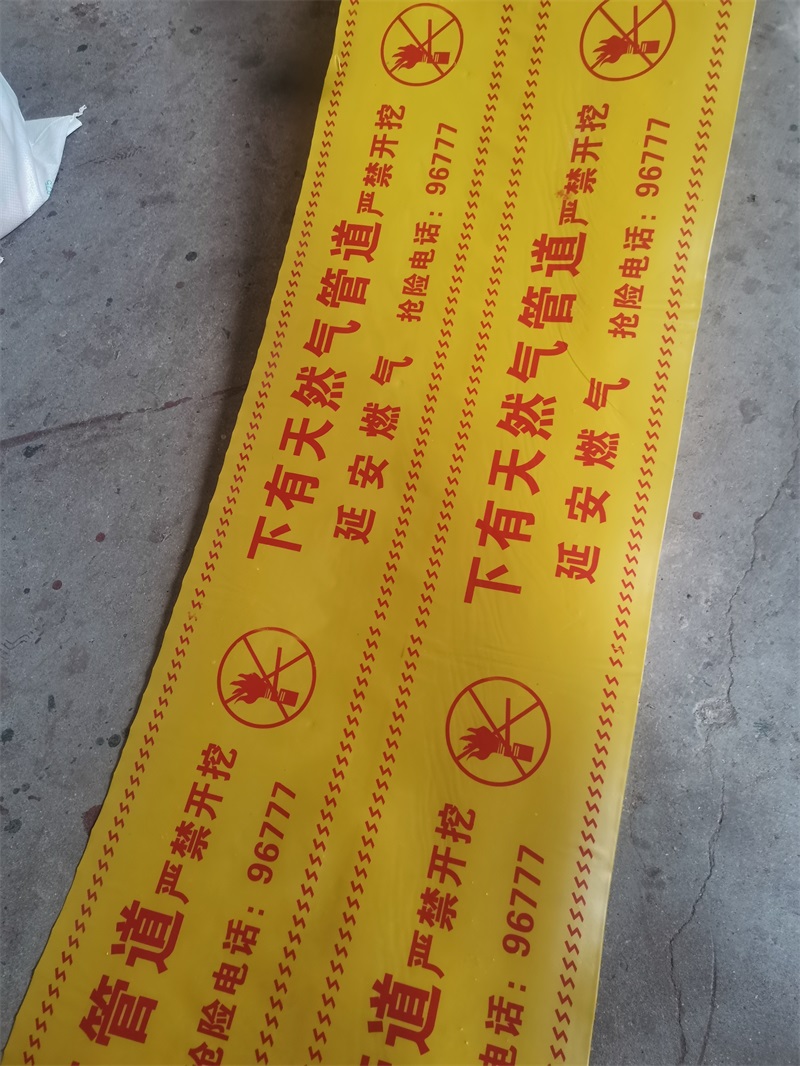
Copper clad steel, copper core wire and copper clad aluminum are buried above the same PE gas pipeline. The total length of PE pipe is about 717m, and then the conductivity and corrosion resistance of three tracer wire are tested. And intensity, and then conduct data analysis to comprehensively evaluate the tracer.
Copper clad steel tracer wire has obvious advantages in strength. It can also meet the needs of detection and tracing when conducting detection signals, and the construction is more convenient. If the anti-corrosion treatment of the joint can be done well, the tracer wire is cost-effective.
The copper core trace line has excellent conductivity to the detection signal, but the anti-corrosion method of the joint is relatively simple, the anti-corrosion quality of the joint can not be guaranteed, and the strength is slightly poor. Therefore, copper core wire should not be used as a tracer wire for buried gas pipelines.
Copper clad aluminum tracer wire has no advantage in strength and signal transmission. If the anti-corrosion treatment of the joint is not good, it will be completely corroded and broken within 1-2a. Therefore, it is not suitable for tracer of buried gas pipeline.
Therefore, we have tested the above three commonly used tracer wire, which provides a reference for the selection of PE gas transmission pipeline from the aspects of tracer wire conductivity, anti-corrosion treatment of tracer wire joints, and tracer wire strength. To help you, please follow us http://webtest2.daoshangbao.cn Learn more!


 Binzhou Hengtong Electric Power Equipment Co., Ltd.

 Phone: +86 183-6493-6808
 Address: No. 112, Qianqiao Village, Haifeng Subdistrict, Wudi County, Binzhou, Shandong, China
 Binzhou Hengtong Electric Power Equipment Co., Ltd.
 ICP record: Shandong ICP 2022018583-1
Shandong Public Security Record 37162302000525