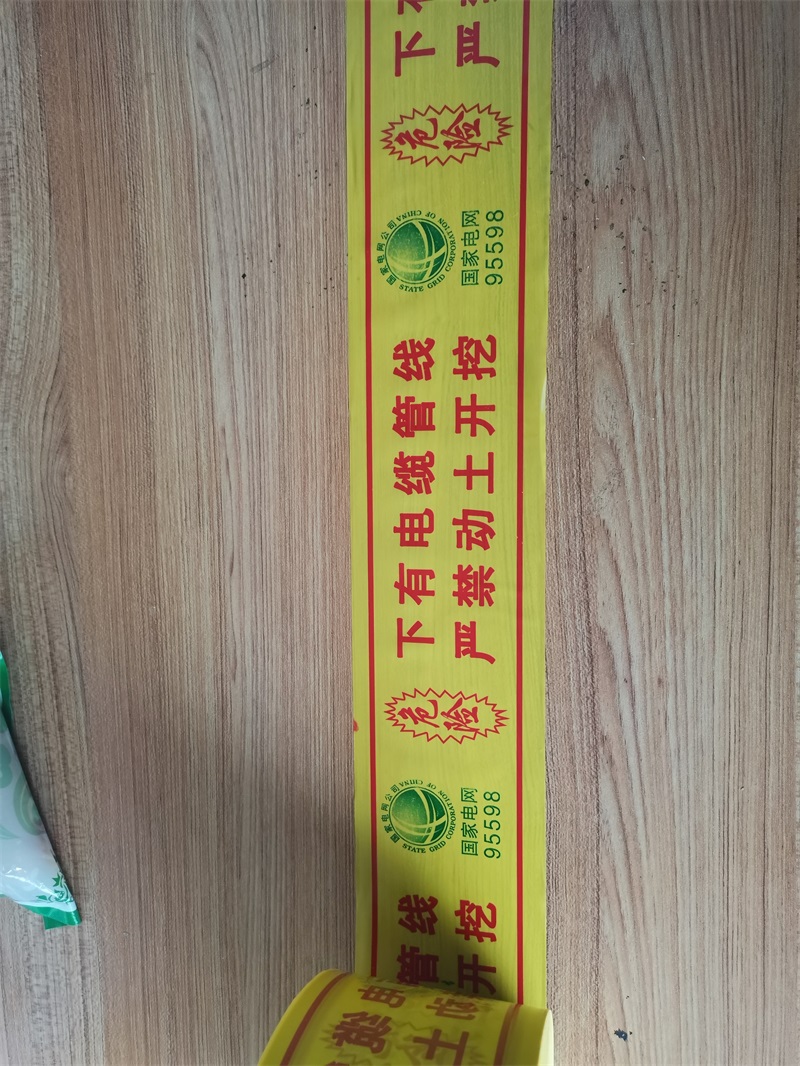
There is a cable warning tape laying
(1) The warning tape of the trace cable is placed 300-500 mm above the top of the pipe (to ensure that the trace belt will not be damaged when the construction is dug out), but it should not be placed in the roadbed or the road surface.
(2) Pipes with a diameter of not more than 400 mm can be laid a trace cable warning belt above; more than 400m M pipes should be parallel to the two trace cable warning belts with a horizontal net distance of 100-200 mm on the parallel directly above the pipeline.
(3) During the laying process, the connection between the two trace cable warning belts should be lap together for about 1 meter, and the PE film on the side of the aluminum foil should be peeled off to reveal the aluminum. Foil, make the aluminum foil of the two trace belts fully contact, and use plastic tape to wrap the overlapping part as a whole to ensure that the bonding is firm, and it can be turned on after power on.
(4) At the end of the PE pipe, if the track belt does not lead out the ground, the trace belt should be peeled off 50 cm long, so that the aluminum foil is in full contact with the earth, and the aluminum foil and the earth form a loop to reduce the contact resistance, which can improve the detection quality.
(5) The signal source well can be set during the laying process, and the trace belt can be drawn out and left in the well for 1 meter, which is convenient for detection.
(6) The overall knurling of the trace belt is formed and placed in rolls and transported in rolls. During construction, open the track belt for 4-5 meters, the two people grab the two ends with their hands and flatten them, and the trace belt will be flattened after letting go. Then lay it again.
(7) The partial over-excavation part should be refilled and compacted. When there is no groundwater at the bottom of the ditch, the super-dig is within 0.15m, and the original soil can be backfilled; When there is groundwater at the bottom of the ditch or the amount of water is large, it should be backfilled to the elevation with graded sand and gravel or natural sand. After the over-excavation part is backfilled and compacted, the density should be close to the density of the natural soil of the original foundation.
(8) In the collapsible loess area, it is not advisable to construct in the rainy period, or to effectively eliminate the accumulation of water in the ditch during construction.
(9) When the bottom of the ditch encounters waste structures, hard stones, wood, garbage and other debris, it must be removed, and a layer of sand or plain soil with a thickness of not less than 0.15m should be laid, and the compaction and design elevation should be leveled.
(10) Frozen soil, garbage, wood and soft substances shall not be backfilled. The backfill soil within 0.5m on both sides of the pipe and above the pipe top shall not contain debris such as gravel and bricks, and shall not be backfilled with lime soil. The stones in the backfill soil with a distance of more than 0.5m from the top of the pipe shall not be more than 10%, and the diameter shall not be greater than 0.1m, and shall be distributed evenly.
(11) The backfill soil should be layered and compacted, and the thickness of each layer should be 0.2~0.3m, and the backfilling soil within 0.5m above the pipe and above the pipe top should be Manual compaction must be used, and the backfill soil with a pipe top of 0.5m can be compacted by small mechanical compaction, and the thickness of each layer of virtual paving should be 0.25~0.4m.
(12) Alert belts should be laid continuously along the line buried with gas pipelines. Before laying the warning belt, the laying surface should be compacted, and the flat laying is directly above the pipe.


 Binzhou Hengtong Electric Power Equipment Co., Ltd.
 Address: No. 112, Qianqiao Village, Haifeng Subdistrict, Wudi County, Binzhou, Shandong, China
 Binzhou Hengtong Electric Power Equipment Co., Ltd.
 ICP record: Shandong ICP 2022018583-1
Shandong Public Security Record 37162302000525


 Phone:
 Email: